Princeton, NJ · Garage Door Service
Is Your Older Princeton Garage Door Worth Fixing
Princeton homes mostly date to the 1960s and 70s. Here's how that age, plus our cold winters, decides whether your door is worth repairing or replacing.
- Repairs & new doors
- Springs & openers
- Serving 7 nearby communities
How Local Conditions Play In
Most of the housing stock in this part of New Jersey went up between 1938 and 2004, with the median landing around 1966, and the 61 named areas we work across - from Kingston three miles out to Somerset twelve miles north - skew heavily toward that 1960s-70s build era. That matters because the doors and openers installed then were sized for hardware specs that have since changed twice over. A torsion spring rated for a wood panel door from 1968 is not the spring a big-box store stocks for a modern insulated steel door, even if the opening is the same width.
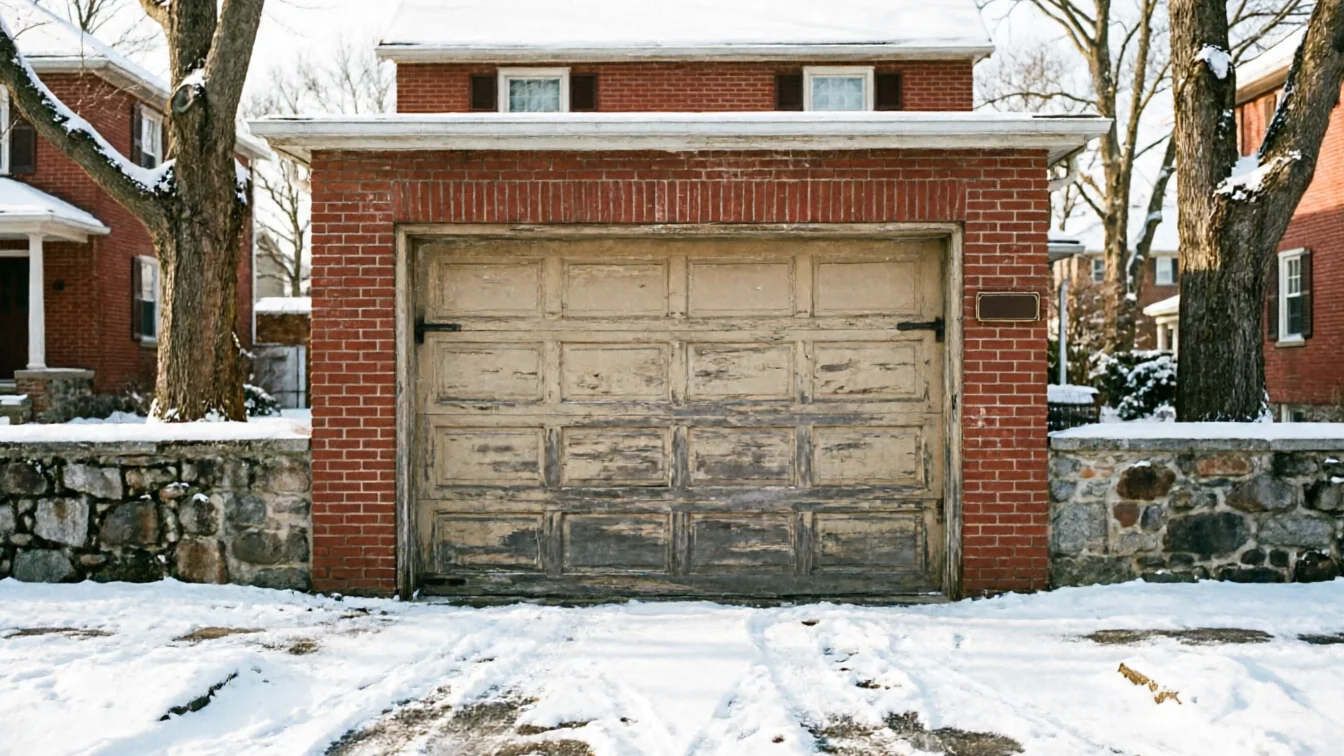
The cold is the other half of it. This area sits in the severe end of the cold climate band, which means a garage door isn't just a security barrier, it's part of the thermal envelope for anyone with a finished space above or behind it. An original door from that era usually has no insulation value worth mentioning, and the weatherstripping on a door that age has almost always hardened past the point of sealing against a January wind. On a 1966-vintage door, the question isn't whether the seal has failed, it's how long it's been failing.
What It Costs
We're not going to hand you a number here, because the honest answer depends on what's actually wrong - a dented panel on an otherwise sound 1970s steel door costs a lot less to fix than replacing a full double door with insulated panels and a new opener. What we can tell you is how the math tends to run. If the springs, rollers, and tracks are the issue, repair almost always makes sense regardless of the door's age, because that hardware is standardized enough that we can match it even on an older jamb.
Where it gets harder to justify repair is when the door panels themselves are warped, rusted through, or no longer available because the manufacturer discontinued that profile decades ago. At that point you're not paying to fix the door, you're paying to keep patching something that will need the same attention again in a year. Given that median household income across this service area runs near $108,851 and most households here are owner-occupied, we find most owners would rather pay once for a door that's actually insulated for our winters than keep sinking smaller amounts into a shell that was never built for it.
The Common Mistake
The mistake we see most often in homes from this era is replacing the opener and stopping there. A homeowner's opener dies, they swap it for a new one, and the door still won't hold its seal or run quietly because the actual problem was the track alignment or a spring that was undersized for the door's weight to begin with. A new opener on bad hardware just means a stronger motor straining against the same friction.
The other version of this mistake runs the other direction: tearing out a sound mid-century door because one spring broke. A broken torsion spring on an otherwise solid panel door is one of the most straightforward repairs there is, and it doesn't mean the whole unit is failing. With 84,817 owner-occupied houses in this area and a housing stock that leans older, we see plenty of doors from the 1960s and 70s that still track true and seal fine once the spring and a couple of rollers are replaced. Age alone isn't the deciding factor. What's failing, and whether parts for it still exist, is.
The Situation
Here's where we land honestly: if your door is from the original construction era for this area - call it 1960s through the 1970s given the median build year of 1966 - and the panels are intact, repair is usually the right call. Springs, cables, rollers, and openers are all replaceable on that vintage without much trouble. Where we draw the line is discontinued panel profiles or wood doors that have taken on moisture damage over fifty-plus winters in a severe cold climate; at that point we'll tell you straight that replacement is the better use of your money, not because we'd rather sell a new door, but because patching rotten wood or an unmatched panel is money that doesn't last.
We can't quote you a price without seeing the door, and we won't pretend every repair is simple. Some older torsion setups use spring sizes that take longer to source than a same-day stock part. If that's your situation, we'll tell you upfront what the wait looks like before you commit to anything.
Frequently asked questions
My garage door is original to the house, is it too old to fix?
Not necessarily. A lot of houses in this area date to the 1960s and 70s, and the hardware from that era - springs, rollers, cables - is still replaceable. What actually rules out repair is panel damage: rust-through, warping, or a discontinued profile. If the panels are sound, age by itself isn't a reason to replace.
Why does my old door feel cold air in winter even when it's shut?
This area sits in a severe cold climate band, and doors built before modern insulation standards usually have little to no insulation value plus hardened weatherstripping that no longer seals tight. That gap lets cold air through year-round, not just during storms. It's worth checking the seal before assuming the whole door needs replacing.
Will a new opener fix my noisy old door?
Usually not on its own. If the noise comes from worn rollers, a bent track, or a spring that's the wrong size for the door's weight, a new opener just runs a stronger motor against the same friction. We'd rather diagnose the track and hardware first and tell you honestly if the opener is actually the problem.
Related garage door services in Princeton
More garage door guides
Book garage door service in Princeton
Call now or request a quote - tell us what the door is doing and where you are.