
Princeton, NJ · Garage Door Service
Why Your Garage Door Jumps the Track in Princeton
Princeton's older housing stock and severe cold winters put real stress on garage door track hardware. Here's why doors jump track here and what actually fixes it.
- Repairs & new doors
- Springs & openers
- Serving 7 nearby communities
How Local Conditions Play In
Most of the housing around Princeton went up between 1938 and 2004, with the typical build year landing around 1966. That matters for track problems specifically, because a door built or rehung in that era is running on steel track bolted to wood jambs that have moved over sixty-plus years. Wood shrinks, settles, and twists a little every season, and when the jamb moves, the track bracket moves with it - just enough that a roller starts catching the edge instead of riding flush.
Princeton sits in a climate band we'd call cold and severe, and that's not just a winter inconvenience. Freeze-thaw cycling works at every bolt, lag screw, and track seam on an exterior wall. Ice forms in the track channel overnight, a door gets forced up against it in the morning, and a roller pops the lip instead of pushing the ice clear. We see this most on doors facing north or west, where the slab stays shaded and the ice sits longer.
Across the 61 named areas we service near Princeton, that same 1960s-70s build window shows up again and again - different street, same hardware problem.
None of this means your door is failing. It means the track alignment that worked in 1966 doesn't always hold on a house that's shifted since.
What It Costs
We don't post a flat number for track repair because what's actually wrong varies too much to quote blind - a roller replacement and a bent track section are two different jobs with two different bills, and we're not going to guess over the phone and then surprise you on site.
What we can tell you: across our service area, median household income runs around $108,851 and there are roughly 184,255 households total, with 84,817 of those owner-occupied. That's a lot of houses built in the same stretch of decades, which means track and roller wear is common enough that we see it constantly, not as a rare emergency call. A straightforward roller or bracket fix is usually the smaller end of the job. A track that's actually bent - not just loose - costs more because the whole section needs replacing, not just realigning.
The honest caution here: if your opener has been fighting a misaligned track for a while, the motor and gears may have taken damage too. We'll tell you if that's the case rather than quote you for a track fix that doesn't solve the real problem.
The Common Mistake
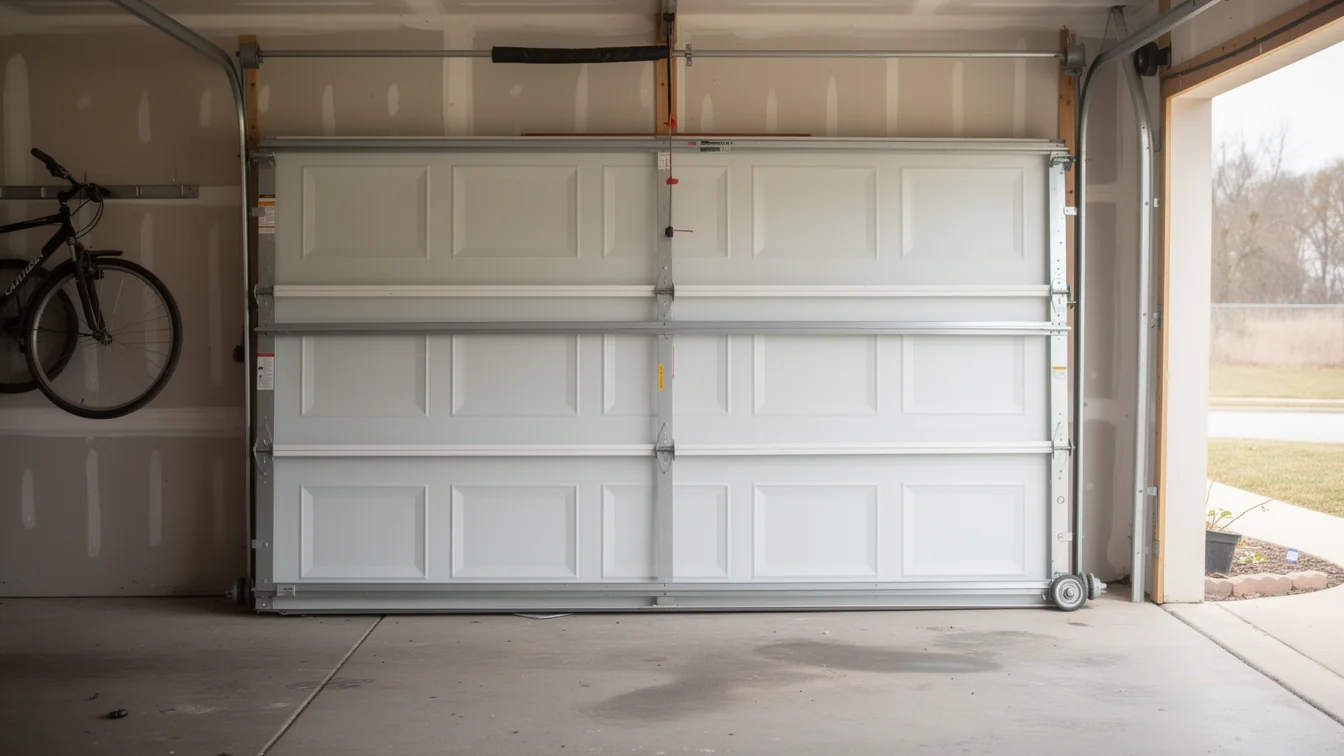
The mistake we see most is someone noticing the door is off track, muscling it back into the channel by hand, and calling it fixed. The door runs again, so it looks solved. It isn't. If a roller jumped the track once, something pushed it there - a loose bracket, a bent rail, a cable that's starting to fray - and that cause is still sitting in the opening waiting to do it again, usually at a worse moment.
The second version of this mistake is running the opener anyway, hoping the motor will force the door back into alignment. On a door with original 1960s-70s hardware, that's how you turn a fifty-dollar bracket problem into a bent track or a torn panel. The opener has no idea the door is binding; it just keeps pulling.
We'd rather you leave the door down, call, and let us look at the track and bracket before anything gets run again. Sometimes it's a ten-minute tightening job. We won't know, and neither will you, until someone's looked at where the roller actually left the channel.
The Situation
We work out of Princeton and cover the towns around it - Kingston, Rocky Hill, and Princeton Junction are all about three miles out, with Montgomery, Heathcote, and Skillman a bit further at five. Hopewell, Princeton Meadows, and Monmouth Junction sit in the six-to-eight-mile range, and we go as far as Manville and Ringoes on the outer edge of the area.
That's a wide stretch of houses built across the same general decades, which means track and alignment calls come in from all of it, not just one neighborhood. A bracket pulling loose from a jamb in Skillman and one doing the same in Dayton are usually the same underlying problem, just on a different street.
We show up, look at where the track is actually separated from the bracket or the rail, and tell you straight whether it's a realignment or a replacement. We don't stretch a small fix into a bigger job, and we don't pretend a bent track will hold if it won't.
Frequently asked questions
Why did my garage door suddenly jump off the track overnight?
Usually it's ice. Princeton's winters sit in the severe cold band, and if moisture gets into the track channel and freezes overnight, the door can catch on the ice in the morning and pop a roller loose. It's more common on north- or west-facing doors that stay shaded.
Can I push the door back onto the track myself?
You can get it running again by hand, but that doesn't fix why it came off. If a bracket is loose or the track is slightly bent - common on houses built in the 1960s and 70s - it'll happen again, often worse. Leave it down and have the bracket and track checked first.
Is a door off track always a track replacement?
No. Often it's a loose bracket or a worn roller, which is a smaller job. A full track replacement only comes up when the rail itself is actually bent, not just misaligned. We check which one it is before quoting anything.
Related garage door services in Princeton
More garage door guides
Book garage door service in Princeton
Call now or request a quote - tell us what the door is doing and where you are.